Eye Doctor La Messa CA
Eyeglasses Designer Sunglasses and Designer Frames
Dry Eye Eye Doctor
Eye Doctor Glaucoma
Cataract Eye Doctor
Children's Vision
Infant SEE
Contact Lenses La Mesa CA
Sitemap
Home
|
About Us
Meet Your Doctor
Meet Your Vision Team
Office Tour
Insurances
Notice of HIPAA Privacy Practices
Internal Access Only
Email
Email Admin
Patient Forms
Tools
|
Contact Us / Maps
Inter-active Maps
Phone / Email / Contact Us
Refer a Friend!
|
Eyewear Gallery
Frame Shape selection Guide
Preferred Frame Designers
About Sports Vision
Sports Vision Designer Frame and Lens Chart
Test your EyeQ
Recommended Lenses
General Lens Type & Material Information
HOYA Lenses
Hoyalux GP Wide
Hoyalux iD
Hoyalux iD Lifestyle
Hoyalux Summit
Varilux Lenses
Varilux Physio 360 - Unique Progressive Lenses
Varilux Ellipse 360 - Progressive Lens for Small Frames
Varilux Liberty - Progressive Lens for long time Bi/Trifocal wearers
Varilux Panamic 360 - Progressive Lenses
Varilux Comfort - Progressive Lenses
Varilux Comfort 360 - Progressive Lenses
Varilux Progressive (Invisible) Lenses
Zeiss Lenses
Zeiss Access
Zeiss Business
Zeiss Claret
Zeiss Gradal Individual / Short i
Zeiss Gradel Brevity
Zeiss Gradal RD
Zeiss Gradal Top
Zeiss GT2
Zeiss Individual
Zeiss SOLA Compact ULTRA
Zeiss SOLOMAX
Zeiss SOLAOne
Polarized Lenses
Transitions (Lenses That Change Colors)
1.74 Thin & Lite High Index Lens
HOYA 1.70 Hi Index
HOYA - Super HiVision Treatment
Crizal Anti-reflective Treatment
Crizal Avanc with Scotchguard
Zeiss Carat Advantage
Zeiss with Teflon Clear Coat
FAQ's Eyeglasses
|
Pediatric Vision
Infant Vision
PreSchool Vision
School Age Vision
Amblyopia or "Lazy Eye"
Protective Eyewear
Computer Impact on Children's Vision
InfantSEE
About Sports Vision
Sports Vision Designer Frame and Lens Chart
|
Eye Conditions
Cataracts
What is a Cataract?
Is Cataract surgery right for me?
The Cataract Procedure
What to Expect; Before, During, & After
Cataracts FAQ's
Ocular Allergies
Diabetic Retinopathy
Detached Retina
Dry Eye
Floaters & Flashes
Conjunctivitis
Amblyopia or "Lazy Eye"
ARMD (Age Related Macular Degeneration)
Glaucoma
Ocular Allergies
Computer Vision Syndrome
Low Vision
i>
|
Contact Lenses
Types of Contacts Lens
Lens Care & Handling Instructions
Soft Lens
Acuvue Brand
General Information
1DAY Acuvue
1DAY Acuvue MOIST
Acuvue 2
Acuvue 2 Colours
Acuvue Advance
Acuvue Advanced for Astigmatism
Acuvue Oasys for Astigmatism
Acuvue Bifocal
Acuvue Oasys
Acuvue Toric
Bausch & Lomb
Boston MultiVision
Optima
PureVision
SilSoft
SofLens
Ciba Vision
General Information
Bifocal Lenses
Focus DAILIES
FreshLook Ciba Color Selector
FreshLook Light Skin & Light Eyes
FreshLook Medium Skin & Dark Eyes
FreshLook Dark Skin & Dark Eyes
Lenses for Astigmatism
Air Optix for Astigmatism
Air Optix Aqua
Night & Day
Specialty and Prosthetic Lenses
Wild Eyes - See the Wild Eyes in Action
Download a Wild Eyes Screen Saver
Cooper Vision
General Information
Avaira
Biofinity
Biomedics
ClearSight
Expressions
Cooper Lens Selector
Expressions
Expressions Accents
Crazy Lenses
Frequency
Hydrasoft
Preference
Proclear
synergeyes
Contact Lenses FAQ's
Contact Lens Care Solution
Alcon Opti-Free Replenish
Bausch & Lomb ReNu
CIBA Aquify/CIBA Clear Care
Order Contact Lenses
|
LASIK
LASIK
What is LASIK
Am I a candidate for LASIK
The LASIK procedure
How it Works- The Wave Print System
What to Expect- Before, during & after
PDF Booklet Myopia (Nearsighted)
PDF Booklet High Myopia (Nearsighted)
PDF Booklet Hyperopia (Farsighted)
PDF Booklet Mixed Astigmatism
FAQ's LASIK
FAQ's IntraLase
Custom
Vue
LASIK Movie
LASEK
What is LASEK
Am I a candidate for LASEK
The LASEK procedure
How it Works- The Wave Print System
What to Expect
PDF Booklet Myopia (Nearsighted)
PDF Booklet High Myopia (Nearsighted)
PDF Booklet Hyperopia (Farsighted)
PDF Booklet Mixed Astigmatism
FAQ's LASEK
Epi-LASIK
What is Epi-LASIK
Am I a candidate for Epi-LASIK
The Epi-LASIK procedure
How it Works- The Wave Print System
What to Expect
PDF Booklet Myopia (Nearsighted)
PDF Booklet High Myopia (Nearsighted)
PDF Booklet Hyperopia (Farsighted)
PDF Booklet Mixed Astigmatism
FAQ's Epi-LASIK
PRK
What is PRK
Am I a candidate for PRK
The PRK procedure
How it Works- The Wave Print System
What to Expect
PDF Booklet Myopia (Nearsighted)
PDF Booklet High Myopia (Nearsighted)
PDF Booklet Hyperopia (Farsighted)
PDF Booklet Mixed Astigmatism
FAQ's PRK
Visian ICL
What is Visian ICL
Am I a candidate for Visian ICL
The Visian ICL procedure
What to Expect
FAQ's Visian ICL
Verisyse Phakic (IOL)
Refractive Lens Exchange

|
CRT
What is Corneal Refractive Therapy (CRT)
The Corneal Refractive Therapy Candidate
How Corneal Refractive Therapy Works
What to expect from Corneal Refractive Therapy
Corneal Refractive Therapy FAQ's
|
FAQ's
FAQ's Eyeglasses
FAQ's Contact Lenses
FAQ's Varilux
FAQ's Glaucoma
FAQ's Cataracts
FAQ's Dry Eye
FAQ's Varilux
CRT FAQ's
FAQ's LASIK
FAQ's IntraLase
FAQ's LASEK
FAQ's Epi-LASIK
FAQ's PRK
FAQ's Visian ICL
Vision Glossary
Find us on Facebook
Eyeglasses, Designer Frames, Designer Sunglasses, & Eye Health Examinations since 1961
New View
Optometric Center
7339 El Cajon Blvd., Suite. G
La Mesa, CA 91942 |
Map It
!
(619) 465-7900
>
Make an Appointment
>
Print Office Form
>
Office Tour
>
Current Events
>
On-line Coupons!
>
Post/Read Testimonials
>
Dry Eye Evaluation
>
LASIK Questionnaire
>
Evaluate Your Visit
>
Order Contact Lenses
>
Optical Illusions
>
Optical Multimedia
Proud Member of the
American Optometric Society
Refractive Lens Exchange
An intraocular lens implant placed permanently in the eye once the natural lens has been removed helps reduce or eliminate the need for glasses or contact lenses after refractive lensectomy.
Refractive lens exchange is a procedure designed to reduce a person’s dependence on glasses or contact lenses. The eye has a lens that works much like the lens of a camera to keep things in focus.
Sometimes, the power of that natural, human lens is not correct for the eye. The result is blurred vision from either nearsightedness, or farsightedness or astigmatism.
Refractive lens exchange can correct these vision disorders by replacing the eye's natural lens with an artifical plastic lens known as an intra-ocular lens implant. The power of the artificial lens that will work best is determined by painless in-office measurements done before the procedure.
The latest advance in refractive lens exchange surgery is the use of bifocal-like intraocular lens implants called “multifocal implants” which not only reduce or eliminate the need for glasses to see far away, but which also make it possible to read and see up-close with little or no need for glasses.
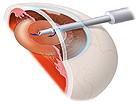
The tip of a pencil-sized instrument painlessly vacuums the clear lens out of the eye through a tiny incision after breaking it into fragments with ultrasound.
The refractive lens exchange procedure is painless. It usually takes about 20 minutes and is performed under a local or topical anesthetic in an outpatient surgery center. Once the eye is numb, a tiny opening about the size of pencil tip is made in the cornea, or clear front window of the eye. The tip of a pencil-shaped instrument is then placed through the incision and emits sound waves (ultrasound) to break the natural lens into tiny fragments. This same instrument then vacuums out the fragments.
Next, an appropriately-powered plastic implant is folded up like a taco and inserted through the same small incision. The lens implant unfolds inside the eye and remains there permanently. The incision is so small that it generally requires no stitches. You are on your feet the same day, back to almost all of your normal activities the next day, and usually seeing very well – with little or no need for glasses—within a day or two.
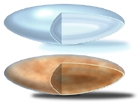
The same surgical technique is used to remove cataracts, usually in people over the age of 65. A cataract is a cloudy lens that prevents a person from seeing well even with his or her best pair of glasses. Cataracts usually occur as a normal part of aging. Refractive lens exchange involves removing one’s natural lens while it is still clear, and not yet cloudy. While cloudy vision is the main indication for cataract surgery, a desire to decrease or eliminate the need for glasses or contact lenses is the main indication for refractive lens exchange.
Clear lens removed in
refractive lens exchange
Yellowed, cloudy lens removed in cataract surgery
Refractive lens exchange is most often recommended when a patient is not a good candidate for laser vision correction procedures to reduce or eliminate the need for glasses or contacts. They may have a need for correction that is beyond the range of laser vision correction, corneas that are too thin for laser vision correction, or an eye condition that makes laser vision correction unsafe or unwise.
Refractive lens exchange is not generally recommended for people under 45 years of age, although there can be exceptions. It is not covered by insurance, unless one’s natural lens is affected by a significant cataract. And, as with any surgery, complications are possible. However, it is generally considered to be quite safe and quite effective for patients who are appropriate candidates.
At the time of your visit, we will determine whether or not you are a
good candidate for this procedure, and will explain it in more detail.
© All content is the property of
New View Optometric Center
™ & assoc. vendors. |
DISCLAIMER
Website Powered and Developed by
EyeVertise.com
- 800-943-1411